Subtitle: Trout Unlimited's plan to destry the people, the economy, and property rights in San Juan County, Colorado, and their complete disregard for the economy and security of the United States of America
Preamble: Certain factions in the environmental movement are dedicated to the extermination of communities, industries, private property, and the rights of individuals, and they defend their actions as justified pursuit of a greater good. It is easy for them to pursue these campaigns, because they believe they have nothing to loose themselves and power to gain if they succeed. Yet this sort of unbalanced assessment of the consequences of their actions is every bit as much a threat to the U.S. economy and national security as a terrorist attack. And to the communities, businesses, and individuals that these rogue environmentalists are willing to sacrifice, it feels like all out genocide.
This document describes one such campaign currently under way. The campaign is being led by Trout Unlimited in San Juan County, Colorado.
Overview: Trout Unlimited is trying to lock up the land around Silverton as a National Conservation Area despite the objections of the large majority of Silverton residents and the San Juan County Commissioners.
Area residents object, because the best promise for making a good living in the area is mining. However, Trout Unlimited says mining must be restricted (read ‘stopped’) to defend the interests of sportsmen.
The mines around Silverton have played a strategic role in the defense of the U.S. in the past and the minerals they contain continue to be critical to the U.S. economy, defense, and renewable energy.
The San Juan County government voted “No” to the proposed National Conservation Area twice. (See County Resolution #2010-02, dated April 28, 2010) Over 50% of the Alpine Triangle as defined by Trout Unlimited is in San Juan County.
Ty Churchwell of Tout Unlimited commented that the San Juan County Commissioners shouldn’t have voted on the proposal and that this proposal was of “far more concern economically and recreationally than is the possible wealth of a few who wish to exploit.” (April 22, 2010 Silverton Standard. Page 9)
Trout Unlimited consults regularly with John Salazar on the progress of their campaign, and the Department of the Interior is also pushing this agenda. The Secretary of the Interior is Ken Salazar who commented that this area is worthy of special management or congressional designation (i.e. National Conservation Area/National Monument)
Both of the Salazar’s have abandoned mine-related water restoration efforts at pivotal moments suggesting their support for restoration is a political decision, not a matter of conviction.
Any money you give to Trout Unlimited may make its way to the proposed economic genocide of Silverton and the surrounding area.
What is Trout Unlimited? (from the Trout Unlimited web site)
“Trout Unlimited is a national organization with more than 150,000 volunteers organized into about 400 chapters from Maine to Montana to Alaska. This dedicated grassroots army is matched by a respected staff of lawyers, policy experts and scientists, who work out of more than 30 offices nationwide. These conservation professionals ensure that Trout Unlimited is at the forefront of fisheries restoration work at the local, state and national levels.”
Trout Unlimited’s Mission is “To conserve, protect, and restore North America’s coldwater fisheries and their watersheds.”
What is their Alpine Triangle Campaign?
The following quotes from Ty Churchwell come from a video posted to the Trout Unlimited web site.
“The Apline Triangle is a Trout Unlimited / sportsmen-led campaign to protect the BLM land that’s defined by the communities of Lake City, Silverton, and Ouray. What we’d like to protect here is the mining and cultural sites, the recreational resources, and the sporting values associated with this BLM land…. The entire BLM area associated with the Triangle has 195 miles of dirt, four wheel drive, and extreme four wheel drive roads. It’s the headwaters of the Uncompaghre, the Lake Fork of the Gunnison, and the Animas Rivers which are some of the best trout fisheries in the West… It truly is one of the most unique sporting and recreational resources in Colorado, most notably because of the access – the dirt road and four wheel drive access – into this area…”
Trout Unlimited has been openly complementary of the successes of current grassroots water conservation efforts achieved with no outside help.
The following quotes also come from the Ty Churchwell video mentioned above.
“A lot of these rivers, to a large degree, were dead rivers through decades and decades because of the acid mine runoff. It’s being cleaned up as we speak. There are groups who are correcting those problems, and these rivers are becoming better fisheries every year that those cleanups are done.” (The “dead river” statement was refuted in the public meeting in Silverton by people who regularly fished the Animas River in the 1950s and 1960s and described who good the fishing was and is).
Closing down and prohibiting mining activity is Trout Unlimited’s top priority
The following quotes also come from the Ty Churchwell video mentioned above.
“Probably the biggest threat to this area would be the mining industry and the threat that new or additional mines could have on the water quality of these trout rivers. What we’re trying to protect here are sportsmen’s values to a large degree and therefore the hunters and the anglers are playing a very big role, but it’s worth noting that the economic resources associated with this area, most notably the recreational resources, the campers, the ATV users, and so forth have a huge economic impact on these three communities… The threat is that new mines could come in at any time, and although we mine more responsibly than we did 100 years ago, the economic or ecological downfall could be severe.”
Trout Unlimited claims the economic benefits for the effected communities would be much greater if current recreational activity continued and mining was prohibited. This assertion contradicts the facts.
Here are some key statistics on San Juan County. According to Kimberly Buck, Executive Director of the San Juan Development Association,
2008 Median Household Income:
Colorado: $57,184
San Juan County: $40,252 (including people who have moved to the area
with independent incomes and don’t need to work)
Poverty for a family of 4 in 2009: $22,050 or lower
In addition, over 50% of the students in the Silverton School District are “in need” or “some form of need” (source: private communication in conjunction with our charitable giving to the Silverton School District).
In contrast, full-time miners typically make $45,000 to $100,000.
There are thousands of mining claims in the area, and geologic studies indicate that just just two of those mines currently contain over 1 million ounces of gold, not to mention other valuable minerals, that can be mined profitably at today’s prices (April 30, 2010).
The following quotes also come from the Ty Churchwell video mentioned above.
“One of the things that we would advocate for is our belief system that these resources up there are worth much more economically for these three communities as a visual resource, as a recreation resource, and as a hunting and fishing resource than it would be as a short term mining resource. Roughly 300,000 people a year come to visit the Apine Triangle and they do so that they can visit the cultural and heritage sites, and utilize the off-roading experience that’s available to them to literally drive and see this amazing place. They’re spending their money in the communities of Lake City, Ouray, and Silverton. But because of the Durango and Silverton Narrow Gauge railroad the town of Durango definitely has an economic interest in the Triangle, as do the communities of Montrose and Gunnison.”
Despite these 300,000 annual visitors, the fact is that per household income in Silverton today is 30% below the State average and $18,202 above the poverty line. As a miner an individual can make 173% the current household average in the County, and there are many years of mineral reserves to be mined..
Does the word "genocide" overstate the case? No.
The definitions of genocide by the International Criminal Court include:
(b) Causing serious bodily or mental harm to members of the group;
(c) Deliberately inflicting on the group conditions of life calculated to bring about its physical destruction in whole or in part;
R.J. Rummel writes :
" 1) The perpetrator is not necessarily a state's government or
its military, but may be an international organization, such as a UN
peacekeeping one, NATO, or a terrorist or guerrilla organization, among
others.
2) Genocide is generally believed to involve the murder of indelible
group members. But the crime does not. Acts (b)-(e) make clear genocide
may also involve the intent to destroy a group by means other than killing
one or more of its members."
It is clear that Trout Unlimited is dedicated to removing the practical ability to mine in the Alpine Triangle and is therefore dedicated to making it difficult for the people of Silverton to make a living. That’s because, to mine today, you have to access Federal Lands in one form or the other. If you remove the access to Federal Lands, you remove the practical ability to mine. Trout Unlimited knows this. With the destruction of the ability to mine comes the destruction of the long term economic viability of Silverton and its people.
We have seen this sort of single-minded, self-serving, systematic assault on a group of people before in the U.S. This is the story of the American Indians, which we now recognize, with shame, as genocide perpetrated in pursuit of land, resources, and ultimately power. Needless to say, successfully creating the Alpine Triangle National Conservation Area, would be a real coup for Trout Unlimited and the politicians who share their vision.
The mines are critical to the livelihood of the people of Silverton
The economics of tourism and recreational visitors barely keep the residents of Silverton out of poverty, and Trout Unlimited wants to keep them there. As already stated, the 300,000 people who visit the area each year make it possible for the people of Silverton to scratch a living on an average per household income of $40,252. That’s not prosperity by any measure.
In contrast, as a miner, an individual can make $45,000 to $100,000 a year, and the Silverton Area mines have many decades of productive life ahead. No wonder Silverton and San Juan County are pro-mining.
Yet, here we are, generations after the lands, homes, and resources of the American Indians were stolen and their populations decimated, and Trout Unlimited is trying to take the land and resources from the current landowners and residents of San Juan County and Silverton. Remarkably, this is just as commodity prices are making mining viable again. The County and Town have seen many years of prosperity from the mineral industry in the past, and the time has arrived for that prosperity to return.
However, if Trout Unlimited is successful in pushing through the National Conservation Area, poverty and despair are the future for the people of San Juan County and Silverton and for the people who have devoted large parts of their lives to preserving and attempting to re-open mineral production in the San Juan Mountains. The history of the western U.S. in the last twenty years has seen examples people committing suicide when their right to mine their property has been taken away. Do you really want to donate to a group dedicated to destroying the lives of others?
The mines are critical to the US Economy and to National Security
The area around Silverton contains some of the most highly mineralized land in the world, including huge strategic resources that are essential to the health of the US Economy, to National Security, and to renewable energy.
In fact, during World War II men from San Juan County were exempt from the draft to ensure there were sufficient natural resources to produce the arms and transport vehicles needed by our armed forces. Understandably, Silverton was, and still is, very proud of the role it played in the War.
Even today, the area still represents a rich reserve of strategic materials critical to our Country, which are required for the production of hybrid cars, solar panels, military armor, cooling systems for all types of power plants, modern electric motors, cell phones, and computers among other things. Many of these metals are only found as by-products of primary metals. The available inventory is dwindling. Production is dropping, and the U.S. is sourcing them heavily from other countries, particularly China. (http://www.commodityonline.com/news/We-are-living-in-the-age-of-technology-metals-13893-3-1.html)
According to the U.S. Geological Survey, some of the strategic metals that can be found in area mines in large quantities are:
Indium: used in the manufacture of solar panels. San Juan County probably has the highest indium grades in the world. These grades are documented in U.S. geological Survey Professional Paper 535. A large proportion of the world’s indium production comes from China, which is starting to cut off strategic mineral exports of indium and other metals.
Tungsten: used for welding and in numerous electrical and military applications. According to the U.S. Bureau of Mines, San Juan County has very high grade tungsten deposits (up to 40% tungsten ore content), yet the US currently imports significant amounts of the tungsten it consumes from China.
Molybdenum: used to strengthen steel and for high temperature greases. Molybdenum is very important for armor plate production. San Juan County has at least three known large molybdenum deposits in the proposed “National Conservation Area.”
Bismuth: used for pharmaceuticals and chemicals. Bismuth is currently heavily sourced from China. The Alpine Triangle has bismuth resources, in addition to other strategic metals such as tellurium, which is also heavily sourced from China. In a time of war, the strategic mineral resources of the Alpine Triangle being available to mine may make the difference between victory or defeat for the U.S. and its allies.
Antimony: used in semiconductors, alloys and batteries. Antimony is currently heavily sourced from China. San Juan County has very large antimony resources.
Manganese: used in many high strength alloys and in electronics. The U.S. Geological Survey conducted a large amount of research on the large manganese deposits of San Juan County, and the U.S. Government considered building a large manganese mine and smelting complex in San Juan County during the Korean war, due to a shortage of this metal for the war effort.
Gold: used to manufacture semiconductors which are the heart of everything electronic from cell phones, cars and TVs to weapons, satellites, and aircraft. To date, the western San Juans have produced over 8.4 million ounces of gold (current value of $10 billion), and just two of the mines in the Silverton Area contain upwards of one million ounces of gold that can be profitably mined at today’s prices (April 30, 2010).
Silver: also used in electronics and medicines. The western San Juan Mountains have produced over 175 million ounces of silver, worth over $3.2 billion at today’s prices.
Plus, the historic production of lead, zinc and copper from the western San Juan Mountains has been over $4 billion.
The total recorded mineral production of the western San Juan Mountains exceeds $17 billion dollars (source: 1993 article by Paul J. Bartos in the SEG Newsletter). The mineral resources currently in place probably exceed $30 billion dollars.
Locking up this resource will compromise America’s ability to produce consumer, industrial, and defense-related products. Is that something you want to do given the Country’s goal of becoming energy and resource independent, the global recession, and the fact that we have two armed conflicts going on with American soldiers being killed each week? It is insane to close this off. If a “National Conservation Area” generates an additional $2 million dollars a year in economic “benefits” to the three communities, it will take 8,600 years of “additional” recreational income to equal the mineral production of the last 120 years. There is no comparison whatsoever between the economics of a National Conservation Area versus keeping the multi-use basis of the lands that has worked so well and been enjoyed by so many over the decades. You don’t have to graduate from Harvard with a degree in economics to figure this out!
Trout Unlimited is hiring an outside consultant to study the potential economic impact of the National Conservation Area. Unfortunately, it is very rare for a consultant to come to a conclusion different from the one sought by their client, and if by chance they do reach a different conclusion, the report is buried. In other words, the report can be counted on to show “large” “economic” benefits from the potential for marginal increase in recreation visitors to the area under their plan, even though nothing could be farther from the truth.
Trout Unlimited is collaborating with Congressman John Salazar and Secretary of the Interior Ken Salazar on this Campaign
Trout Unlimited called a public meeting led by Ty Churchwell in Silverton on March 31, 2010. During the meeting, Mr. Churchwell informed the group that he had been working closely with Congressman John Salazar’s office, communicating with them at least once a month for a year to discuss the progress of the Alpine Triangle Campaign.
Also at the meeting, a community member circulated a paper opposing the Campaign and spelling out why it was a threat to the town of Silverton. (To read that paper click here.) The paper asserts that the Department of the Interior is also collaborating with Trout Unlimited. The paper was mentioned specifically at a subsequent County Commissioner Meeting held on April14, 2010, and one Commissioner vigorously refuted one from the paper (that the U.S. gold reserves may have been sold over the years).. However, no one denied the behind-the-scenes involvement of the Department of the Interior in the Trout Unlimited campaign.
It is also well known that, at the request of the Secretary of the Interior, the Bureau of Land Management (a DOI agency) identified the Alpine Triangle as a candidate for inclusion in the National Landscape Conservation System. This fact came to light when a DOI/BLM document was leaked and made its way to members of the Silverton community. (To read the document click here. Go to page 5.)
Given the above data points and the power of the Department of the Interior, those who oppose the Alpine Triangle Campaign need to assume the Department of Interior is involved.
Despite their rhetoric, both John and Ken Salazar have histories of cold heartedly abandoning pivotal opportunities to restore damaged coldwater fisheries and their watersheds. Their commitment appears to be a matter of politics, not conviction.
Let’s examine the Salazar brothers.
John Salazar, Congressman for the 3rd District of Colorado
Congressman Salazar’s web site includes a biography that starts with a quote and the following paragraph.
“Congressman John Salazar is dedicated to defending rural values and ensuring that the government keeps its promises to the people. Now in his third term, Congressman Salazar comes to Congress after serving in the Colorado State Assembly, where he gained recognition for protecting rural water and leading the fight to defeat Referendum A.”
Despite his reputation for protecting rural water, the Congressman turned his back on an opportunity to designate $630,000 in Federal funds to Colorado in 2008 (for actual delivery to the State in 2009) to test a state-of-the-art water treatment technology useful for cleaning up mining discharge. In particular, the technology was developed by Blue Sky Technologies (www.blueskytechnologies.biz) and had been proven effective in removing almost all metals from mine discharge coming out of mines in California (such as the Mill Bull Tunnel, Leviathan Mine, Mammoth Mine, Iron Mountain Mine), and Montana (such as the Berkeley Pit).
This breakthrough water treatment technology was sought, and found by a small mining company in San Juan County. It was also found independently by the U.S. Army Corps of Engineers who suggested doing a pilot demonstration at the San Juan company’s mine. To obtain funding for the pilot, the Corps of Engineers informed the mining company that a spending authorization bill allocating millions of dollars for mine restoration was winding its way through Congress, and that $630,000 of it was available for Colorado if a Congressman would insert the appropriate line appropriation into the bill. Specifically, the bill was for the U.S. Army Corps of Engineers Restoration of Abandoned Mine Sites Program (RAMS) which was expanded under the Water Resources and Development Act of 2007, H.R. 1495, (WRDA), an Act that was vigorously backed by Congressman Salazar (http://www.house.gov/list/press/co03_salazar/PR_1_080207.html). At this point, the mining company enthusiastically volunteered to donate a parcel of its private land for the water treatment plant site. The local watershed protection group also approved the idea, and the mining company approached their local congressman, John Salazar (who was actually on the relevant appropriations subcommittee), asking that he insert the necessary language into the bill. In addition, the U.S. Corps of Engineers also communicated their support for the plan to Congressman’s office.
It took many weeks for the mining company’s Environmental Affairs Manager to get a reply from the Congressman’s office, but she eventually received word that a senior staff member wanted to meet her. It looked like the plan was moving forward. Rather, than give the plan life, however, the meeting killed it, as the senior staff member spent the entire time browbeating the woman for having the audacity to suggest Colorado participate in the appropriation. While the woman kept her composure during the meeting, she sobbed in recounting it and stated she was so afraid of Congressman Salazar she would deny the meeting ever took place (although supporting documentation does exist).
There might be sense to this sequence of events if the Congressman had had another, preferred, mining project in mind that he wanted to insert into the bill. However, the WRDA section of the Energy and Water Development Appropriations Bill, 2009, allocated no funds to any mining-related projects in Colorado whatsoever. Therefore it is clear that pursuing responsible mining in San Juan County conflicts with the Congressman’s interests, either because he is against all mining in the State or he has other plans for San Juan County specifically. Either way, the more he can demonize mining companies as greedy polluters, the better.
Ken Salazar, Secretary of the Interior
In his first speech to the employees of the Department of the Interior on January 22, 2009, Ken Salzar said the following:
“My family’s livelihood depended
on the health of our land. Our parents taught us about the importance
of water and about the importance of land. Because the sustainability
of our family depended on how we took care of our land and our water,
they taught us that we had to be responsible stewards of the water,
soil, and wildlife around us, so that we could preserve the balance
that allows us to ranch and farm, generation after generation.”
(http://www.doi.gov/news/speeches/2009_01_22_speech.cfm)
These words suggest Secretary Salazar would vigorously pursue known, large scale polluters. Yet, in 2003, when he was Attorney General of the State of Colorado and accountable for ensuring mining companies lived up to their environmental responsibilities, he allowed a large public mining company to walk away from a massive discharge of heavy metal laden water that is still flowing unchecked and untreated today.
Picture of Ken Salazar Memorial Mine drainage:
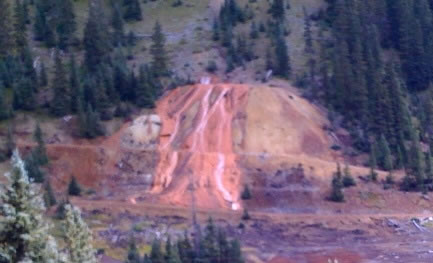
(Photo taken in September of 2009.)
This is a picture of the Red & Bonita Mine one half mile from Gladstone, Colorado, and seven miles from Silverton. Prior to a bulkheading project at the neighboring Sunnyside Mine designed to hold back mining discharge, the Red & Bonita was know as a “dry mine” without any significant drainage. However, after installation of the final plug in the American Tunnel of the Sunnyside Mine, a stream of 200+ gallons per minute of heavy metal-laden water started to flow from the neighboring Red & Bonita, and other mines in the area began to sprout heavy water too. Together, these new flows produced an equivalent discharge volume to the Sunnyside prior to closure. However, not to worry: the pollution in the above picture is not going onto Federal lands. The pollution stream is draining onto one of the many parcels of private land in San Juan County. (In fact, this land is owned by the author of this document, while the mine entrance is owned by another private person.)
Not only are the Red & Bonita and other mines affected by the Sunnyside plug still flowing today, but the American tunnel is also discharging up to 100 gallons per minute despite the installation of plugs.
When the formerly dry mines ruptured and
started to discharge large volumes of heavy water, the owner of one
of the mines filed a law suit against the owner of the Sunnyside. Remarkably,
the suit was still active when then Attorney General Ken Salazar had
his department negotiate to vacate a judicial consent decree with the
Canadian owners of Sunnyside via “pollution trading”. (Case
94CV5459 District Court of City and County of Denver)
In other words, even though there was an ongoing public dispute against
Sunnyside’s owners for failing to contain the problem, Attorney
General Salazar not only authorized the removal of the consent decree
and released the Canadian company’s legal obligation to treat
the Sunnyside Mine’s discharge, but he also returned a $5 million
bond for cleanup of potential future water damages to the Mine’s
Canadian owners. In fact, as Attorney General he signed away all of
Colorado’s future rights to pursue Clean Water Act or other legal
remedies against them. This was in exchange for the Canadian company
performing four minor mine remediation projects elsewhere, at least
two of which benefited the Company directly (See
article here: link to “What Lies Beneath”).
No one knows why the Secretary Salazar let the Canadian owners of the Sunnyside Mine off the hook when he was Attorney General of the State of Colorado, but the fact is he did. And to this day, the legacy of that decision is affecting the headwaters of the Animas River and its associated watershed. Doubtless, this is a story he has yet to share with Trout Unlimited.
Could closing off the San Juans to mining be treason?
Closing off the San Juan Mountains to mining will affect the long term defense of the United States. Once an area is closed off to mineral extraction, it is almost impossible to bring back that mineral production, especially in ten years or less. All of America’s wars have been won (or lost) in less time than that. Closing off the San Juans to mining would undermine our economy, our national security, and therefore our government in both the short term and the long term, and that’s the definition of treason “a crime that undermines the offender’s government.” Whether this is an act of treason is not to be determined here, but the full implications of shutting off the mineral resources contained in the Alpine Triangle need to be considered.
Time is of the essence
The Department of the Interior is actively creating new National Monuments as we speak. In May 2010, Secretary Salazar submitted a bill to make the Chimney Rock area in Colorado a National Monument. Chimney Rock is one of the targeted areas identified by the BLM for National Monument status.
In summary
The Alpine Triangle has almost unrestricted access now for fisherman, hunters, ATV riders, and other sportsmen. The multiple use and access to the area is in fact a triumph for the counties in the area, and the multiple use status is already creating economic benefits for the communities in those counties. In fact, to protect those benefits, a local stakeholders group is already successfully cleaning up area rivers with no outside help. There is no need to change the land use status and no need to designate the area a “National Conservation Area.”
Therefore, the only arguments that remain for creating a National Conservation Area are to ban mining from the area, to ultimately transition the area to National Monument and/or National Park status, and to acquire stature (a.k.a. power) from “delivering” a unique natural resource to American sportsmen, even though the resource was already available to them and even though “delivering” it required closing off other natural resources in the area critical to all of the people of the United States and to the Country’s armed forces.
Finally, given that the area has produced over $17 billion in mineral production over the years and over $30 billion remains to be mined, no amount of additional “recreational access” can compare to the economic benefits of mining to the area. Trout Unlimited has targeted a specific group of people and the community of Silverton to suffer the effects of economic genocide, in order to further Trout Unlimited’s and the Salazar brothers’ agenda. This agenda is against the long term interests of the United States of America.
Dedication
This document was prepared in memory of Richard who died June 9, 1941 during the Invasion of Normandy.
And it is dedicated to his great nephews who are currently serving in the United States armed forces.
We will not let Trout Unlimited strip this Country of access to its strategic resources or of its ability to protect and defend its soldiers and citizens.
The content of this website is solely the responsibility of The Gladstone
Institute, Inc. (a Colorado corporation) which is dedicated to sponsoring
reasonable debate of the economic future of the United States and sensible
use of its natural resources.
For more information contact: gladstoneinstitute@hotmail.com